

Anyone researching a move to Norway, or trying to understand how the local job market and pay work, usually starts by looking at the national average salary. The problem is that this number from Statistics Norway (SSB) doesn’t reflect most people’s reality, so will not give you a good understanding of the system.
The Local explains why this figure is largely a myth (at least for the majority of the population).
What is the current 'average' salary?
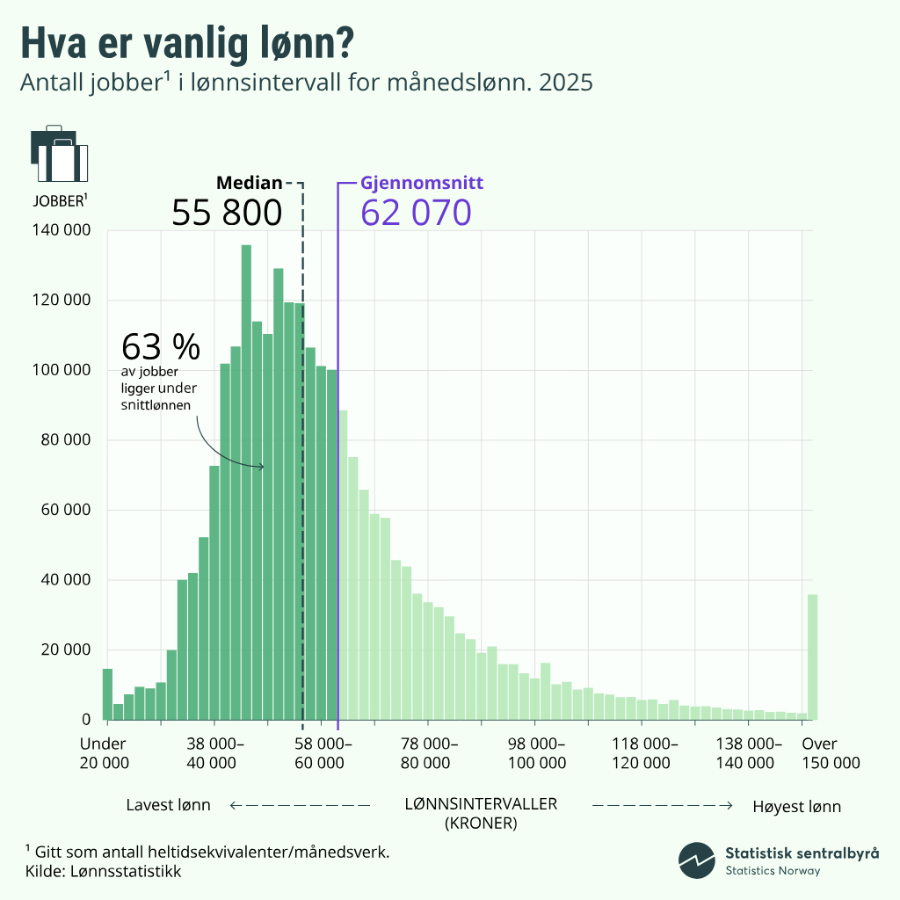
Every year, SSB calculates the average salary (gjennomsnitt) by looking at all salaried jobs in the country. In 2025, the average monthly wage for a full-time job was 62,070 kroner before taxes, or about 744,840 kroner per year.
On paper that sounds pretty good. But as SSB themselves admit, many of the workers won't be seeing that figure in their own payslips as the average is rarely going to be a very realistic indicator of what a 'normal' salary actually is.
In fact, almost two thirds, 63 percent, of jobs in Norway pay less than the official average.
Why is this figure so far from reality?
To obtain the number of the average salary, SSB adds up all the wages from full-time jobs in Norway and divides that total by the number of jobs. Since there’s no limit on how much someone can earn in Norway, a small group of very high earners pushes the national average up, far above what most people actually get paid, creating a statistical trap.
If you look at specific jobs, you can see how big pay gaps cause this distortion. For instance, SSB’s data shows that a managing director earns an average of 108,510 kroner a month (including bonuses, overtime, and other extras) while a cleaner earns 43,700 kroner, a difference of over 64,000 kroner.
Looking at the extremes, one of the highest paid jobs is that of an oil and gas extraction manager at 132,900 kroner per month. At the other end of the scale is a livestock farm helper at 33,500 kroner. That's a staggering 99,400 kroner per month difference, which skews the average salary.
The median salary
To get a more realistic and accurate picture of what a typical worker earns in Norway (and a better guide for what to negotiate in your job interviews), economists and statisticians use the median salary, which was 55,800 kroner before tax for full-time jobs in 2025 (around 6,270 kroner less per month than the average).
The median salary is the exact middle point of all salaries if they were lined up in order, and it isn’t affected in the same way by very high earners at the top.
It is easier to understand using the chart below, from SSB. As you can see above, full-time monthly wages (lønnsintervaller in the graph) range from about 20,000 kroner to over 150,000 kroner. That long tail to the right is what inflates the average, while the median stays much closer to where most people are.
However, the bad news is that though the median is much closer to reality, it’s still higher than what many people actually earn nowadays. This is especially true for newcomers to Norway, who often start out earning much less than these figures.
The actual difference
There can still be a big difference between the average and median salary in the same job.
Take the same example of managing directors or CEOs mentioned earlier. While the average monthly salary is 108,510 kroner, the median sits at 84,000 kroner (and in reality, it is not uncommon to meet people holding these titles in smaller companies who earn closer to 45,000 or 60,000 kroner).
The same happens with a huge variety of other positions. Financial analysts average 84,480 kroner, but the median is 75,360 kroner, a gap of 9,120 kroner; restaurant chefs average 58,740 kroner, with a median of 52,610 kroner, journalists have an average of 67,220 kroner and a median of 64,630 kroner.
In some jobs, though, the gap isn’t as big. For example, nurses have an average salary of 58,290 kroner and a median of 57,830 kroner, a difference of just 460 kroner, and bus drivers average 47,630 kroner, with a median of 47,270 kroner a month (a gap of just 360 kroner). You can search for your profession in the full list here.
This can generate a lot of confusion and also frustration, which is why SSB advises people working in Norway that instead of relying on the national average, it’s best to check the specific numbers for your job and sector in SSB’s wage database. This is the most accurate way of seeing what your role really pays, as in Norway your pay also depends on many factors, such as your age, experience, and education.
SSB also has a wage calculator.
The catch of the part-time percentage contracts
All of these figures and calculations are based on full-time roles; however, in Norway you will find many jobs that are only advertised as 60, 50, 40, or even 20 or 10 percent contracts. So, if you’re on a part-time contract, or paid by hour, these attractive numbers won’t match at all what you actually take home at the end of the day.
The reality is that you could end up living on a salary of between 20,000 and 30,000 kroner a month before tax.
So, if you’re job hunting or thinking about moving to Norway, remember this when planning your household budget and your future.
Comments