
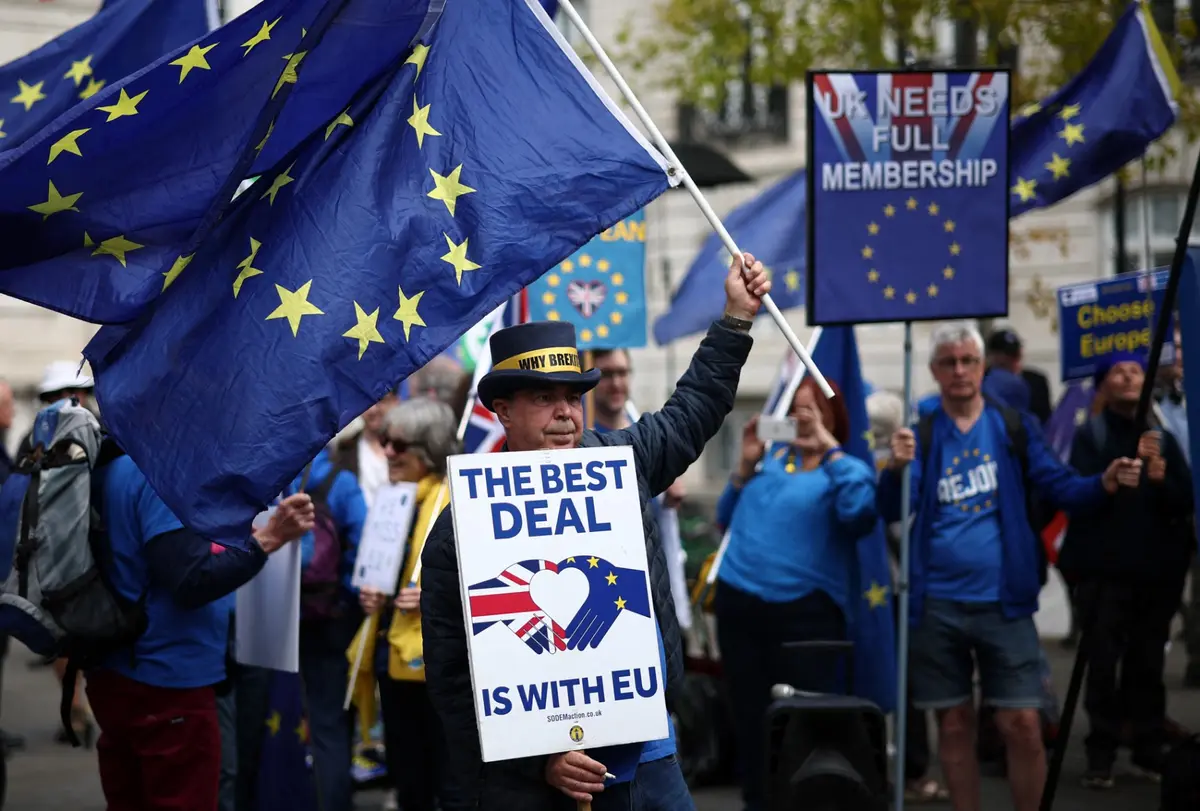
The EU and the UK will hold their second summit after Brexit in Brussels on November 20th.
The summit was planned for July but it was delayed after the resignation of UK Prime Minister Keir Starmer. It will now take place in a different political context, with the new Prime Minister, Andy Burnham, talking about a national debate on the future relationship with the EU, including the possibility to rejoin and restore free movement of people.
Despite the new narrative, “this summit is really about taking forward some negotiations that were launched at EU-UK summit in May 2025, so the agenda is quite modest, and even that is proving quite challenging to get over the line,” Ian Bond, Deputy Director of the Centre for European Reform, a think tank in London and Brussels, told The Local.
“Both the UK and the EU will try to portray the summit as a success, but the reality is there’s still quite a lot of arguing to be done”, he said.
At the European Parliament debate on the summit last week, European Trade Commissioner Maroš Šefčovič said the EU aims to “complete negotiations… as a package” on trade in agricultural products, the linkage of the EU and the UK carbon markets, and the creation of a youth experience scheme. Negotiations are also ongoing on the UK’s participation in the EU’s electricity market, the Commission added.
Food and electricity
Ian Bond says that the sanitary and phytosanitary agreement is “probably the easiest” to achieve. The agreement will remove trade barriers in food and agricultural products as the UK will commit to adopt the EU's rulebook in the sector.
The UK participation in the EU emissions trading scheme and electricity market should also be agreed. “Both sides want energy trading,” Bond says.
“The offshore wind infrastructure in the North Sea could serve both the UK and the EU, and one of the advantages of being in different time zones is that the peak hours are slightly different on the two sides of the Channel, so there is a benefit to both sides in being able to shift generating capacity back and forth to meet those different peak times,” he added.
In exchange for access to its electricity market, the EU however demands a “quite sizable financial contribution” to the cohesion fund, the programme to reduce disparities among EU regions.
Youth mobility
But the most difficult part of the summit agenda concerns the youth mobility scheme. The scheme will give the opportunity to people aged between 18 and 30 to live, work and travel across the Channel without sponsorship requirements for up to three years.
At the European Parliament debate, Thomas Byrne, Minister for Europe of Ireland, which holds the rotating EU Council presidency, said: “The youth experience scheme is at the heart of our aim to rebuild bridges between the young people across the UK and the EU. It is a key priority.”
Disagreement however persists on the annual cap the UK wants to set on the number of young Europeans who could benefit.
The EU also demands that EU students pay home fees in UK universities (currently £9,790) and are exempted from the NHS surcharge. Since the end of free movement, EU students have to pay international fees, which are much higher, as well as the visa and a fee to access the public health service.
According to the Financial Times, the UK offered a “discount”, which EU Member States still consider insufficient.
“This is a problem for both the UK government and universities because British universities are heavily reliant on the fact that overseas students pay much more than home students. If tens of thousands EU students pay lower fees, that could create a hole in their budget that the government might have to fill,” Bond explains.
Another major source of disagreement is the request by the British government that young Brits be allowed to move from one country to another like during the time of EU membership. This would allow them to work anywhere, for example in a bar in Ibiza during the summer and at a ski resort in Austria during the winter. EU countries say instead that they should get a work permit for only one Member State without the automatic right to move to another.
“This is not a European Commission competence as it is up to each Member State to decide what they do about work visas,” Bond says.
According to media reports, the agreement on the youth experience scheme might be delayed by six months to ensure a positive outcome of the summit.
‘Made in Europe’ and foreign policy
Another issue in discussion will be whether the UK will be included in the ‘Made in Europe’ provisions the EU is discussing to boost local manufacturing and reduce dependence on countries like China. These provisions will concern public procurement and key sectors such as electric cars, aluminium and steel and clean technologies, for which the EU wants to increase local production.
Foreign policy will also be on the agenda, with conclusions expected on support for Ukraine and defence cooperation.
“Apart from these milestones, work is ongoing on strengthening ties in many other areas of mutual interest. This includes health security, police cooperation, judicial cooperation and tackling irregular migration and smugglers’ networks,” Byrne told the European Parliament.
Commercial and emotional relationship
Bond says that talks around the summit “reflect something about the UK's attitude towards the EU that dates back to the 1970s”.
“A lot of people in the UK saw the EU as a trade bloc rather than a political union. The British have tended to see that with the EU much more as a commercial relationship than an emotional relationship, whereas youth mobility, free movement of labour in the single market, and the Erasmus+ programme are partly economic, but also partly about creating a sense of belonging to a single community,” he argued.
“If the EU and the UK are able to finalise all the agreements of the past and a few more forward leaning issues, that will create a good atmosphere for Andy Burnham to launch a national conversation on the EU relationship,” he said.
Comments