
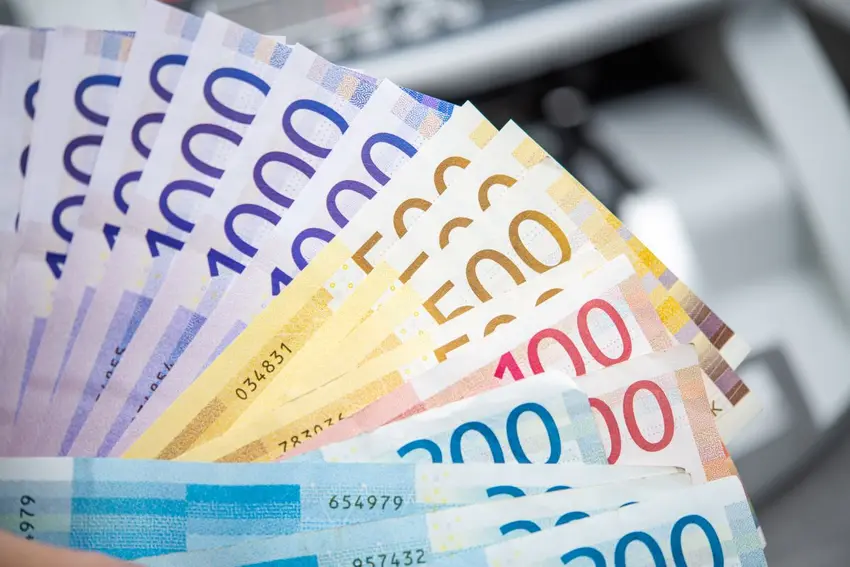
In recent weeks, Norway’s krone has hit a 24-year-low against the pound and a four-year-low against the euro.
Following an already turbulent 18 months, the krone's latest slump has sparked fresh concerns over its future performance and how the currency’s weakness can impact inflation, interest rates and Norway’s residents.
Norway’s Liberal Party, currently in opposition, has called for a parliamentary committee to investigate what the government should do to boost the krone.
“I believe that one should not rule out any possibilities when we see such a dramatic development as now,” Sveinung Rotevatn, deputy leader of the party, told the newspaper Aftenposten.
Meanwhile, the business and financial newspaper E24 canvassed the six biggest parties in Norway (there are nine parties that could be considered part of the political mainstream) about their thoughts on the krone.
The right-wing Progress Party and Socialist Left Party joined the Liberal Party in wanting a committee to consider what could be done about the krone.
Meanwhile, the Centre Party, Labour Party, and Socialist Left Party were all against or sceptical towards a committee. The Conservative Party said it wouldn’t comment as it was formulating its policy on the krone.
The different options available
The prospect of a commission being set up to investigate what can be done about the krone politically has received mixed reactions from Norway’s political parties.
The commission’s aim would be to gather the expert knowledge available to better understand current issues with the krone and consider potential solutions. The committee's recommendations typically end with a decision that parliament will decide on.
Even if a committee was set up, the mixed reaction to the potential idea indicates that the proposed decision may garner less support than it needs to be implemented.
One reason the Centre Party gave for not wanting a committee is that it hasn’t been long since a committee looked into Norway’s monetary policy.
The Liberal Party also proposed tying the krone to a currency like the euro.
Norway currently has a floating exchange rate policy, meaning that its central bank (Norges Bank) does not normally intervene in the market to support the currency and that it isn’t tied to anything.
The Liberal Party pointed towards the Danish krone being tied to the euro as a solution. Over the past year, the Danish krone has typically been worth between 1.5 and 1.6 Norwegian kroner.
One of the factors behind the krone’s weakness is its free-floating nature. Economists have said that the krone's small size makes it more prone to volatility in times of economic turbulence.
Still, the Libreal Party was the only party out of the six to speak to E24 that favoured tying the krone to the euro.
Economists have suggested that reforms could boost the Norwegian krone. Elisabeth Holvik, the chief economist at the Sparebank 1 group, said that reforms focused on increasing productivity in the Norwegian economy would boost the currency.
Holvik has previously suggested to broadcaster TV 2 that the country should pursue a policy similar to the Solidarity Alternative from 1991.
“In that case, it must be that a Solidarity Alternative 2.0 is created, with significant cuts in the public sector, tax reform and mechanisms that ensure long-term sustainability in the economic framework conditions for companies and investors,”
The Solidarity Alternative policy of the 1990s stabilised the Norwegian krone. It was led by trade unions, businesses, and the authorities to ensure better productivity, more moderate wage increases, regulation simplification, and cuts to unemployment.
The scheme has been credited with positive economic development in Norway in the 1990s.
READ ALSO: Why the Norwegian krone is unlikely to return to its historic strength
It’s currently unclear whether the government plans to implement anything similar to this or whether any opposition parties were formulating a policy similar to this.
Why the government may not do anything
The two parties that form the minority government, the Labour Party and Centre Party, were among those to question the need for a commission and signal that they were in favour of maintaining the status quo.
The Socialist Left Party is the current government's preferred budgetary partner, and its support is required to pass the annual budget and key policies through parliament. However, it is unlikely that the Socialist Left Party will push the government to intervene directly.
The responsibility for exchange rate policy falls under the remit of the central bank. Therefore, it is unlikely that the government would directly interfere with the bank’s responsibility and independence.
Furthermore, the bank hasn't offered insight into what it would change beyond using interest rates to boost the krone in order to try and moderate inflation.
READ MORE: Could Norway's weak krone trigger a shock interest rate hike?
Comments