Suu Kyi arrives in Norway for Nobel speech

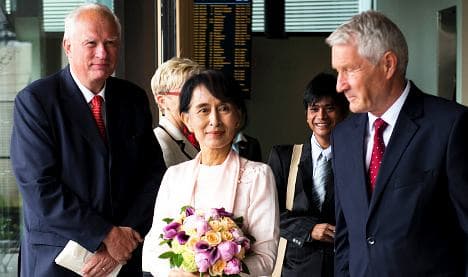
Burma democracy champion Aung San Suu Kyi arrived in Norway on Friday to finally deliver her Nobel lecture, more than
two decades after winning the peace prize for her dogged campaign to free her people.
Suu Kyi's visit to Oslo after years of house arrest and isolation follows sweeping political change in her Southeast Asian homeland, where a former military junta has promised to follow a path to democracy.
But Suu Kyi's first Europe trip in a quarter-century has been clouded by ethnic strife at home, where regional clashes between Buddhists and Muslim Rohingya have claimed dozens of lives and displaced more than 30,000 people.
Speaking in Geneva on Thursday, the Oxford-educated veteran activist and daughter of the country's independence hero stressed "the need for rule of law," saying that without it "such communal strife will only continue."
There was concern over the punishing schedule of Suu Kyi's trip, which will also take her to Britain, Ireland and France, after the frail activist, who turns 67 next week, cancelled some events in Switzerland, citing exhaustion.
A member of her delegation said early Friday that "she feels better, she has a little headache. The programme is maintained as scheduled."
She was later greeted in the Swiss parliament to a rapturous standing ovation, an event that concluded the Swiss leg of her landmark journey.
After her arrival in Oslo, Suu Kyi is to meet Prime Minister Jens Stoltenberg before a dinner at the waterfront Akershus Castle with him, King Harald and Queen Sonja, as well as parliamentarians and Burmese community members.
On Saturday, she is to deliver the traditional Nobel lecture at Oslo City Hall for the prize she won in 1991 but was unable to accept in person, fearing that the regime would bar her from returning to her country.
Instead, she listened to the news on shortwave radio, isolated in the crumbling lakeside mansion in Yangon that was her prison for a total of 15 years since she committed her life to the country also known as Myanmar in 1988.
Her husband Michael Aris and their two sons, Kim and Alexander, accepted the award on her behalf. When her husband died of cancer in 1999, Suu Kyi could not be by his side, for the same reason.
It is Suu Kyi's personal commitment to the struggle that has led admirers to liken the petite woman with the trademark flower in her hair to history's great human rights defenders, from Mahatma Gandhi to Nelson Mandela.
An exhibition at the Nobel Peace Centre at Oslo harbour celebrates "Mother Democracy." Outside a stage has been set up for Suu Kyi to address the people of Norway, a nation which has long backed her democracy cause.
"I'm incredibly impressed by her courage," said 67-year-old Norwegian Buddhist nun Yeshe Chodron, civic name Ingeborg Sandberg, as she strolled through Oslo in her deep-red Tibetan robe earlier this week.
"The fact that she's now allowed to be a free citizen and carry on with her politics must be a good sign. It seems to me things are brightening up. There seems to be a different attitude now."
Burma's President Thein Sein has freed hundreds of political prisoners, welcomed Suu Kyi's party back into mainstream politics, and signed ceasefires with most ethnic rebel groups, leading Western nations to ease sanctions.
Suu Kyi herself, however, is likely to temper her optimism with caution.
Last month in Thailand, on her first trip abroad in 24 years, Suu Ki warned against "reckless optimism" and said that "the buds have yet to blossom, and the blossoms have yet to turn to fruit."
Burma still faces huge challenges, not least the unrest near the Bangladesh border, which UN rights envoy Tomas Ojea Quintana has said poses a threat to the country's shift towards democracy.
The crumbling economy lags far behind those of its dynamic Asian neighbours, although the eased sanctions have sparked a business bonanza, with investors starting to flock to the resource-rich country.
Coca-Cola said on Thursday it would return to Burma after more than six decades, pledging significant investments.
Suu Kyi, in a speech to the International Labour Organisation on Thursday, said that "democracy friendly" investment that creates jobs in her impoverished country was welcome.
Comments
See Also
Suu Kyi's visit to Oslo after years of house arrest and isolation follows sweeping political change in her Southeast Asian homeland, where a former military junta has promised to follow a path to democracy.
But Suu Kyi's first Europe trip in a quarter-century has been clouded by ethnic strife at home, where regional clashes between Buddhists and Muslim Rohingya have claimed dozens of lives and displaced more than 30,000 people.
Speaking in Geneva on Thursday, the Oxford-educated veteran activist and daughter of the country's independence hero stressed "the need for rule of law," saying that without it "such communal strife will only continue."
There was concern over the punishing schedule of Suu Kyi's trip, which will also take her to Britain, Ireland and France, after the frail activist, who turns 67 next week, cancelled some events in Switzerland, citing exhaustion.
A member of her delegation said early Friday that "she feels better, she has a little headache. The programme is maintained as scheduled."
She was later greeted in the Swiss parliament to a rapturous standing ovation, an event that concluded the Swiss leg of her landmark journey.
After her arrival in Oslo, Suu Kyi is to meet Prime Minister Jens Stoltenberg before a dinner at the waterfront Akershus Castle with him, King Harald and Queen Sonja, as well as parliamentarians and Burmese community members.
On Saturday, she is to deliver the traditional Nobel lecture at Oslo City Hall for the prize she won in 1991 but was unable to accept in person, fearing that the regime would bar her from returning to her country.
Instead, she listened to the news on shortwave radio, isolated in the crumbling lakeside mansion in Yangon that was her prison for a total of 15 years since she committed her life to the country also known as Myanmar in 1988.
Her husband Michael Aris and their two sons, Kim and Alexander, accepted the award on her behalf. When her husband died of cancer in 1999, Suu Kyi could not be by his side, for the same reason.
It is Suu Kyi's personal commitment to the struggle that has led admirers to liken the petite woman with the trademark flower in her hair to history's great human rights defenders, from Mahatma Gandhi to Nelson Mandela.
An exhibition at the Nobel Peace Centre at Oslo harbour celebrates "Mother Democracy." Outside a stage has been set up for Suu Kyi to address the people of Norway, a nation which has long backed her democracy cause.
"I'm incredibly impressed by her courage," said 67-year-old Norwegian Buddhist nun Yeshe Chodron, civic name Ingeborg Sandberg, as she strolled through Oslo in her deep-red Tibetan robe earlier this week.
"The fact that she's now allowed to be a free citizen and carry on with her politics must be a good sign. It seems to me things are brightening up. There seems to be a different attitude now."
Burma's President Thein Sein has freed hundreds of political prisoners, welcomed Suu Kyi's party back into mainstream politics, and signed ceasefires with most ethnic rebel groups, leading Western nations to ease sanctions.
Suu Kyi herself, however, is likely to temper her optimism with caution.
Last month in Thailand, on her first trip abroad in 24 years, Suu Ki warned against "reckless optimism" and said that "the buds have yet to blossom, and the blossoms have yet to turn to fruit."
Burma still faces huge challenges, not least the unrest near the Bangladesh border, which UN rights envoy Tomas Ojea Quintana has said poses a threat to the country's shift towards democracy.
The crumbling economy lags far behind those of its dynamic Asian neighbours, although the eased sanctions have sparked a business bonanza, with investors starting to flock to the resource-rich country.
Coca-Cola said on Thursday it would return to Burma after more than six decades, pledging significant investments.
Suu Kyi, in a speech to the International Labour Organisation on Thursday, said that "democracy friendly" investment that creates jobs in her impoverished country was welcome.
Join the conversation in our comments section below. Share your own views and experience and if you have a question or suggestion for our journalists then email us at [email protected].
Please keep comments civil, constructive and on topic – and make sure to read our terms of use before getting involved.
Please log in here to leave a comment.