Why the hunt for North Sea oil is getting harder

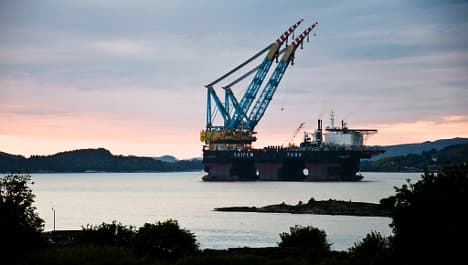
The North Sea has some way to go before running out of oil but faced with falling output, unlocking new reserves is proving technologically complex and expensive, according to experts.
"There are clouds on the horizon but the outlook is bright," said Nils Helge Sorgard, head of business development at oil and gas group Wintershall Norge AS, at a recent energy industry conference in Aberdeen, northeast Scotland.
Around 100 professionals last week converged on the port city, whose economy is inextricably linked to the North Sea energy industry, to assess the future of oil exploration in the waters between Scotland and Norway.
As energy experts got down to business there was a reminder of the dangers faced by the industry, as 240 kilometres from Aberdeen, gas leaking from a North Sea platform forced the evacuation of more than 300 workers.
French oil giant Total, which operates the stricken Elgin platform, said the leak was the most serious problem it had faced in the North Sea in a decade.
At the Oil & Gas Outlook North Sea 2012 conference, experts assessed the industry's outlook against a backdrop of data highlighting a decline in the amount of crude brought to the surface.
Britain's North Sea oil and gas production slumped 54 percent in the decade to 2010, while the British government estimates that it will collapse by a further 60 percent by 2030. Norway's output dropped 5.0 percent between 2000 and 2010.
The government estimates that the area of the North Sea owned by Britain holds roughly 7.8 billion barrels of extractable oil and 4.2 billion barrels of oil equivalent (boe), or gas, that can be brought to the surface.
That is the equivalent to 15 years at current production rates.
Norway's government meanwhile estimates that there are still 40 billion boe that can be extracted from its North Sea waters.
But none of this 'black gold' is easy to grab.
"The easy oil is over and now we have to exploit much (more) difficult oil -- here is the challenge," said Tim Davies, Premier Oil's exploration manager, North Sea.
"We have to push the play deeper and beyond the known extent," he told AFP.
To the north of Britain and west of the Shetland Islands, a series of gas fields pose "quite significant" exploration challenges, according to Garry Dempster, commercial & business development manager at DONG Energy UK.
We are talking about "very deep waters and it's the harshest environment in the UK, with extreme waves and high winds. The development costs and technical risks are high."
Dempster said that the Laggan-Tormore project -- a joint venture with Total -- required an investment of £2.5 billion ( $4.0 billion), including a contribution of £500 million from DONG Energy UK.
But exploration in such remote areas is not vital, according to Premier Oil's Davies.
"Even in areas largely explored in the past, we think there are still resources to be found," he said.
"The challenge will be to keep the existing infrastructures alive to maximise the volume in mature fields ... and continue exploration. It's not an easy game."
Much depends on the oil price. With Brent crude currently trading at over $120 a barrel, funding difficult exploration is feasible. But should a slump occur and oil prices slump to around $70, "it will make a big difference for production," one industry source said.
The industry, which is continually looking for government incentives to help meet the high costs of North Sea oil extraction, won a boost in Britain's recent budget.
Oil & Gas UK warmly welcomed finance minister George Osborne's package of tax measures that the industry body said would result in tens of billions of pounds of additional investment to exploit Britain's oil and gas reserves.
Comments
See Also
"There are clouds on the horizon but the outlook is bright," said Nils Helge Sorgard, head of business development at oil and gas group Wintershall Norge AS, at a recent energy industry conference in Aberdeen, northeast Scotland.
Around 100 professionals last week converged on the port city, whose economy is inextricably linked to the North Sea energy industry, to assess the future of oil exploration in the waters between Scotland and Norway.
As energy experts got down to business there was a reminder of the dangers faced by the industry, as 240 kilometres from Aberdeen, gas leaking from a North Sea platform forced the evacuation of more than 300 workers.
French oil giant Total, which operates the stricken Elgin platform, said the leak was the most serious problem it had faced in the North Sea in a decade.
At the Oil & Gas Outlook North Sea 2012 conference, experts assessed the industry's outlook against a backdrop of data highlighting a decline in the amount of crude brought to the surface.
Britain's North Sea oil and gas production slumped 54 percent in the decade to 2010, while the British government estimates that it will collapse by a further 60 percent by 2030. Norway's output dropped 5.0 percent between 2000 and 2010.
The government estimates that the area of the North Sea owned by Britain holds roughly 7.8 billion barrels of extractable oil and 4.2 billion barrels of oil equivalent (boe), or gas, that can be brought to the surface.
That is the equivalent to 15 years at current production rates.
Norway's government meanwhile estimates that there are still 40 billion boe that can be extracted from its North Sea waters.
But none of this 'black gold' is easy to grab.
"The easy oil is over and now we have to exploit much (more) difficult oil -- here is the challenge," said Tim Davies, Premier Oil's exploration manager, North Sea.
"We have to push the play deeper and beyond the known extent," he told AFP.
To the north of Britain and west of the Shetland Islands, a series of gas fields pose "quite significant" exploration challenges, according to Garry Dempster, commercial & business development manager at DONG Energy UK.
We are talking about "very deep waters and it's the harshest environment in the UK, with extreme waves and high winds. The development costs and technical risks are high."
Dempster said that the Laggan-Tormore project -- a joint venture with Total -- required an investment of £2.5 billion ( $4.0 billion), including a contribution of £500 million from DONG Energy UK.
But exploration in such remote areas is not vital, according to Premier Oil's Davies.
"Even in areas largely explored in the past, we think there are still resources to be found," he said.
"The challenge will be to keep the existing infrastructures alive to maximise the volume in mature fields ... and continue exploration. It's not an easy game."
Much depends on the oil price. With Brent crude currently trading at over $120 a barrel, funding difficult exploration is feasible. But should a slump occur and oil prices slump to around $70, "it will make a big difference for production," one industry source said.
The industry, which is continually looking for government incentives to help meet the high costs of North Sea oil extraction, won a boost in Britain's recent budget.
Oil & Gas UK warmly welcomed finance minister George Osborne's package of tax measures that the industry body said would result in tens of billions of pounds of additional investment to exploit Britain's oil and gas reserves.
Join the conversation in our comments section below. Share your own views and experience and if you have a question or suggestion for our journalists then email us at [email protected].
Please keep comments civil, constructive and on topic – and make sure to read our terms of use before getting involved.
Please log in here to leave a comment.